Industry Trends · General Audience
How Referrals Help You Break the AI Application Doom Loop
Mass applying into AI screening systems is a losing game. Learn how employee referrals break the doom loop, bypass automated filters, and get your resume in front of real people.
Published July 13, 2026
Join the network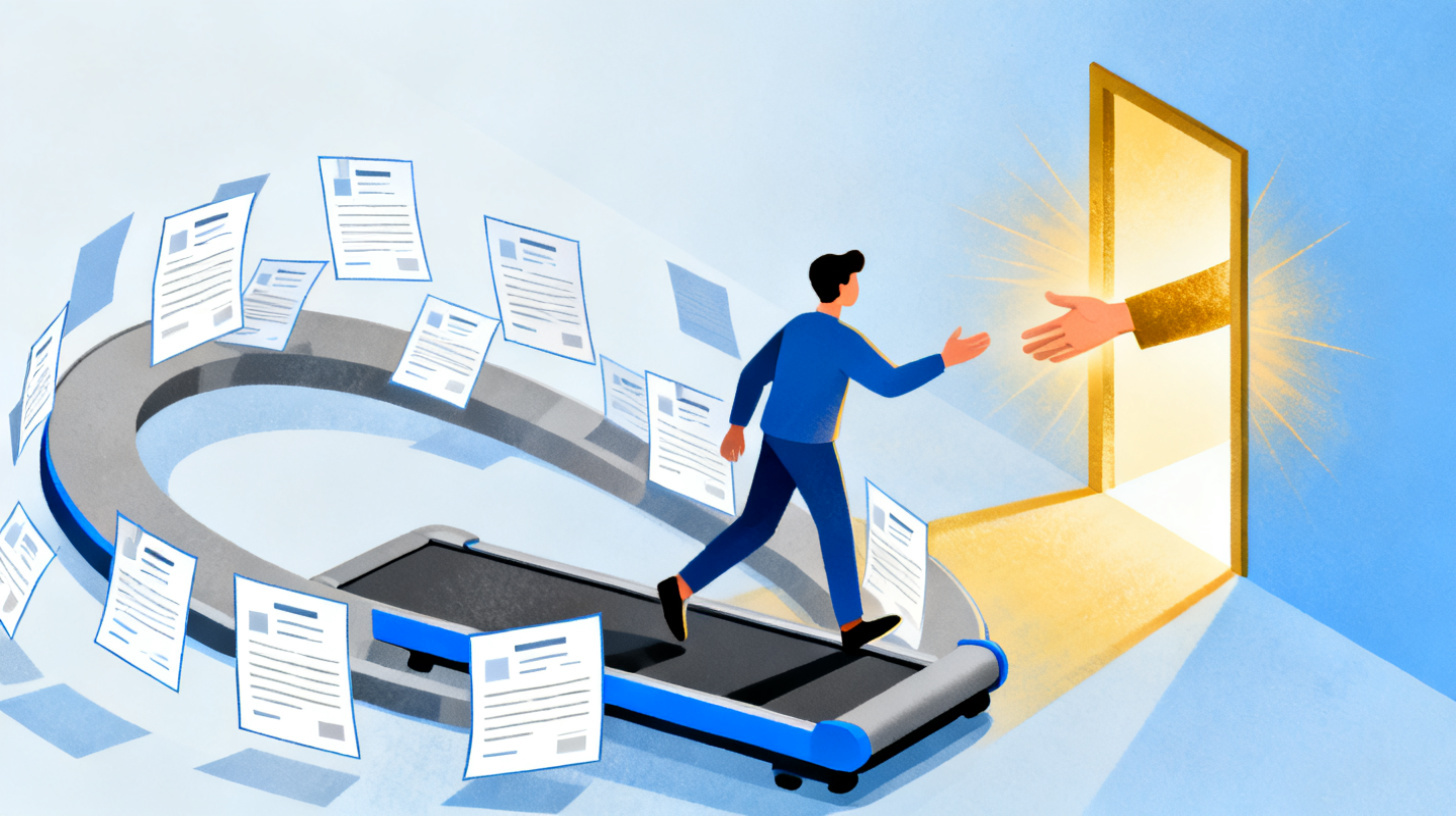
Sections
You've been here before. You spend an hour tailoring your resume, write a cover letter that actually feels personal, click "Submit," and then... nothing. No email. No rejection. Just silence. So you apply to another job. And another. And another. Before long, you've submitted 200 applications and received maybe three automated rejections and one generic "we'll keep your resume on file" reply.
This is the AI application doom loop, and it's quietly crushing the motivation of millions of job seekers. The cycle works like this: companies deploy AI screening tools to filter thousands of applicants, which means most resumes never reach a human. Seekers respond by mass-applying to more roles, which floods inboxes further, which makes companies lean harder on automated filters. Everyone loses.
But there's a way to sidestep the entire machine. Referrals bypass the algorithmic gatekeepers and put your application directly in front of a real person. According to the Bureau of Labor Statistics, millions of job openings go unfilled every month even as millions of people actively search for work. The disconnect isn't a lack of talent or opportunity. It's a broken pipeline. And referrals are the most reliable way to fix it.
If you're ready to stop feeding your resume into a black hole, sign up for ReferMe and start connecting with real employees who can walk your application past the bots and onto a hiring manager's desk.
Inside the Doom Loop: Why Mass Applying Stopped Working
Let's be honest about what's happening on the other side of that "Apply" button. Most large employers now use some form of automated applicant tracking or AI screening system. These tools scan resumes for keyword matches, score candidates against job descriptions, and filter out anyone who doesn't hit a predetermined threshold. The intention is efficiency: when a single job posting can attract 500 or more applicants, hiring teams physically cannot review every resume.
The problem is that these systems are blunt instruments. They penalize unconventional career paths, miss transferable skills, and sometimes reject perfectly qualified people because of formatting quirks or missing buzzwords. If you've ever been told you're "not a fit" for a role you could do in your sleep, an algorithm probably made that call before any human saw your name.
This creates a vicious feedback loop. When applicants realize their carefully crafted resumes aren't getting through, they turn to mass-apply tools and one-click submission features. The logic seems sound: if the odds of any single application succeeding are low, the rational move is to increase volume. But this floods employers with even more applications, which makes them tighten their filters, which drops response rates further.
Here's the math that nobody talks about. If an AI screening system rejects 75% of applicants before a human reviews them, and you submit 100 applications, only 25 even have a chance of being seen. If hiring managers then shortlist roughly 10% of what they review, you're looking at two or three real opportunities from 100 attempts. That's a brutal conversion rate, and it gets worse as more people adopt the same volume strategy.
The emotional toll is just as damaging as the practical one. Repeated ghosting erodes confidence. You start second-guessing your experience, rewriting your resume for the fifteenth time, and wondering if you're somehow unemployable despite years of solid work. The doom loop isn't just inefficient. It's demoralizing.
Mass-apply tools accelerate this problem instead of solving it. They promise efficiency, but what they actually deliver is more noise in an already overloaded system. When everyone uses the same shortcut, the shortcut stops working. You end up competing with thousands of other auto-generated applications, all optimized for the same keywords, all landing in the same algorithmic sorting bin.
The deeper issue is that this entire approach treats job searching as a numbers game when it's actually a relationship game. Hiring has always been, at its core, about trust. A hiring manager needs to trust that a candidate can do the job, fit the team, and stick around long enough to justify the investment. Algorithms can't assess trust. People can. And that's exactly where referrals change the equation.
Why Referrals Short-Circuit the Algorithm
A referral does something no amount of keyword optimization can accomplish: it introduces a human signal into an automated process. When a current employee at a company submits your name through their internal referral system, your application gets flagged differently. In most organizations, referred candidates skip the initial AI screening entirely or get automatically advanced to the human review stage.
This isn't a workaround or a hack. It's how the system was designed to work. Companies actively want referrals because referred candidates tend to be higher quality. The logic is straightforward: an employee putting their reputation on the line by recommending someone is a powerful quality signal that no resume keyword can replicate. Research from SHRM consistently shows that employee referrals remain one of the top sources of quality hires across industries.
Let's walk through what actually happens when you get referred versus when you apply cold.
The Cold Application Path
You submit your resume through the company's career page
An ATS parses your resume and extracts keywords, job titles, and years of experience
An AI scoring algorithm ranks you against hundreds or thousands of other applicants
If you score below the threshold, your application is auto-rejected or deprioritized
If you score above it, a recruiter might glance at your resume for six to ten seconds
If the recruiter likes what they see, you might get a screening call weeks later
The Referral Path
An employee submits your name and resume through the company's internal referral portal
Your application is tagged as "referred" and often routed directly to the recruiter or hiring manager
The employee's endorsement serves as a pre-screening signal, giving your resume immediate credibility
The recruiter reviews your resume with context: they know who recommended you and why
You're significantly more likely to get a phone screen, and it often happens faster
The difference is dramatic. Referred candidates are estimated to be anywhere from 4x to 10x more likely to be hired than cold applicants, depending on the company and role. They also tend to get hired faster and stay longer, which is why companies incentivize employees to refer people in the first place.
But here's the catch that keeps most people stuck in the doom loop: traditional referrals depend on who you already know. If you don't have a friend or former colleague at your target company, the referral path has historically been closed. You're back to cold applications and crossed fingers.
That's the gap ReferMe was built to fill. Instead of relying on your existing network, you can browse open referral opportunities and connect with real employees at companies you want to work for. These aren't random strangers. They're people who have opted in to refer qualified candidates, often because their companies reward them for successful hires. It's a marketplace that aligns incentives: you get a warm introduction, the referrer gets recognition or a bonus, and the company gets a vetted candidate.
The result? You stop competing in a sea of anonymous applications and start showing up as a recommended human being. That single shift can transform your entire job search.
A Practical Playbook for Referral-Based Job Searching
Knowing that referrals work is one thing. Actually building a referral-driven job search strategy is another. Here's a concrete, step-by-step approach you can start using right now.
Step 1: Identify Your Target Companies
Stop applying everywhere. Pick 10 to 15 companies where you genuinely want to work and where your skills align with their needs. Research their products, culture, and recent news. This focused approach lets you invest real energy into each opportunity instead of scattering shallow applications across hundreds of listings.
For each target company, look up who works there. LinkedIn is a starting point, but platforms like ReferMe make this easier by showing you which companies have active referrers ready to help.
Step 2: Build Referral Connections Before You Need Them
The worst time to ask for a referral is the day a job posting goes live. Ideally, you want to have conversations with people at your target companies before you need something from them. This could be as simple as:
Commenting thoughtfully on their LinkedIn posts over a few weeks
Attending virtual events or webinars they participate in
Sending a brief, genuine message about something they've written or built
Joining industry communities where employees of your target companies are active
On ReferMe, this process is streamlined because both sides know why they're connecting. Referrers have already signaled their willingness to help, so you can skip the awkward "I know we've never spoken, but..." preamble.
Step 3: Make the Ask Easy
When you do request a referral, do the work for your referrer. Don't just say "Can you refer me?" Instead, provide:
The specific job posting link and title
A brief summary of why you're a strong fit (three to four bullet points)
Your updated resume tailored to the role
A short blurb the referrer can copy-paste into their company's internal referral system
The easier you make it for someone to refer you, the more likely they are to actually do it. Remember, they're putting their reputation on the line. Give them confidence that you'll reflect well on them.
Step 4: Follow Up and Follow Through
After you've been referred, send a thank-you note to your referrer. Keep them updated on your progress. If you get an interview, let them know. If you get the job, make sure they get credit for the referral (this often triggers a referral bonus for them).
This follow-through isn't just polite. It builds a relationship that can help you throughout your career. The person who referred you becomes an ally inside the company, someone who can give you context about the team, the interview process, and the culture.
Step 5: Combine Referrals with Strong Application Materials
A referral opens the door, but you still need to walk through it. Make sure your resume is tailored to the specific role, not a generic one-size-fits-all document. Your cover letter (if required) should reference the connection and demonstrate genuine knowledge of the company. If you get an interview, prepare thoroughly. The referral gets you in the room. Your preparation keeps you there.
For a deeper dive into how referrals interact with automated screening systems, check out this guide on how referrals help you beat ATS resume screening systems.
Breaking Free for Good: From Doom Loop to Career Momentum
The AI application doom loop persists because it feels like the only option. When every job board has a one-click apply button and every career coach says "it's a numbers game," volume feels like the only lever you can pull. But the data tells a different story. The people who land jobs fastest aren't the ones who apply most. They're the ones who apply smartest, and that almost always involves a human connection.
Shifting to a referral-first strategy requires a mindset change. Instead of measuring success by applications submitted, you measure it by relationships built. Instead of spending three hours a night clicking "Apply" on 30 job listings, you spend that time having two meaningful conversations with people at companies you actually want to join. The pace feels slower at first, but the outcomes accelerate quickly.
Think about it this way. If you send 200 cold applications and get two interviews, your conversion rate is 1%. If you get five referrals and three of them lead to interviews, your conversion rate is 60%. Even if it takes longer to secure each referral than to click "Submit," the return on your time is dramatically higher.
There's also a compounding effect that mass applying simply doesn't offer. Every relationship you build expands your network. The referrer who helps you this month might introduce you to someone at a different company next month. The hiring manager who didn't have the right role for you today might reach out when something opens up. People remember people. Algorithms don't.
The doom loop is real, but it's not inevitable. You can choose to stop feeding the machine and start building genuine connections that lead to real opportunities. The technology that's supposed to streamline hiring has inadvertently made it harder for qualified people to get noticed. Referrals are the antidote because they reintroduce the human element that algorithms can't replicate.
If you're tired of applying into the void, take the first step today. Sign up for ReferMe, explore companies where real employees are ready to refer you, and start turning your job search from a frustrating numbers game into a focused, relationship-driven strategy that actually works. The doom loop ends when you decide to stop playing by its rules.